


Redesigning DataUP for scalable future growth
Project: Since its inception in 2021, DataUP Consulting's digital presence and brand identity have been managed through fragmented, incremental updates that lagged behind the company's actual growth. This reactive approach created a disjointed user experience that failed to communicate the full technical breadth of an emerging data analytics firm located in the Twin Cities. To align their image with their growth trajectory, the leadership team initiated a comprehensive redesign of the DataUP primary website. This new digital hub serves as the definitive showcase for the company's evolving data capabilities, integrated consulting services, and specialized client solutions. Beyond a mere visual refresh, the redesigned site was engineered to function as a scalable growth engine, enabling the marketing and sales teams to rapidly deploy new content and capture higher-quality leads in an increasingly competitive market.
My roles and responsibilities for this project
Currently, I continue to serve as the Design Director for all DataUP website product initiatives as a consultant. Some of my other key responsibilities central to the success of the DataUP product website include:
Strategic Alignment and Vision
I ensure that every design initiative for the DataUP website directly supports the company’s business goals, and I closely work with the CEO to transform strategic outputs into measurable assets that drive long-term profitability.
Design Direction and Execution
I serve as the primary design consultant responsible for the direction, vision, and user experience of the DataUP website to ensure the final product delivers an experience that is accessible, mobile-responsive, and high-performing.
Design System Management
I am responsible for engineering and governing Analog, the DataUP centralized "Single Source of Truth" design system library. A system of reusable components that aligns their design language for development to ensure brand consistency.

The Challenge:
Defining the footprint of a startup to build the voice of a brand
At the outset of the DataUP redesign, the objective was to transform a fragmented digital presence into a high-performing growth engine. Using an OKR framework, the primary Objective was to establish DataUP as the definitive authority in the Twin Cities data landscape by professionalizing the website as a strategic digital touchpoint. The Key Results focused on increasing lead quality by 25% and reducing time-to-market for new pages through a scalable architecture. This initiative provided the opportunity to validate new design patterns as a foundation for future growth. The stakeholders recognized that the solution required more than a visual refresh; it demanded an interface and code structure flexible enough to support rapid, iterative expansion.
To meet these requirements, I engineered Analog — a centralized "Single Source of Truth" design system. By utilizing Figma for high-fidelity prototyping and building components in isolation, I ensured every element was accessible, responsive, and performant. The final output was a feature-rich design ecosystem built on a modular framework developed in Webflow, enabling the deployment of complex layouts while maintaining strict brand consistency. This systematic approach transformed the site from a reactive blog into a robust digital hub that showcases DataUP's technical breadth and integrated consulting solutions.
The following sections document the standards established for developing a solutions-based website product and the strategic process for building Analog and its components.
Discovery:
How strategic alignment would define what success looks like
To ensure the DataUP redesign moved beyond aesthetics, I led a discovery phase focused on strategic alignment with leadership. Through stakeholder workshops and quantitative research, I bridged the gap between business objectives and user needs, defining measurable success criteria before beginning the design phase. This objective-driven framework shifted focus from subjective preferences to growth-oriented prioritization. By codifying these insights early, we ensured that the final product was not merely a website, but a validated business tool designed to convert high-level data expertise into measurable market authority.
Business Goals & KPIs
To transform DataUP into a scalable growth engine, two core objectives were identified to serve as the primary performance indicators of the platform:
-
Lead Quality: Increase the conversion rate of Sales Qualified Leads by 25% through targeted, service-page storytelling.
-
Market Authority: Establish a 30% increase in organic traffic for Twin Cities-based data analytics search queries.
Success Metrics
The following quantitative and qualitative metrics were established to track the long-term health and user viability of the new digital ecosystem:
-
User Retention: A 15% improvement in average session duration, indicating higher engagement with our specialized consulting content.
-
Brand Consistency: 100% adherence to the Analog design system across all new web modules to eliminate visual debt.
Stakeholder Mapping
To build a truly representative platform, I conducted a Stakeholder Mapping exercise to identify the key voices within DataUP Consulting, ranging from executive leadership to lead consultants. By interviewing these team members, I uncovered the unique pain points of each department, ensuring the website would serve both as a powerful sales closer for the CEO and a functional portfolio for the technical team. This collaborative mapping was essential for building the internal trust needed to execute a unified brand vision that resonated across the entire organization.

Building on this internal alignment, I conducted a comprehensive competitive analysis to identify how DataUP's unique value proposition could be differentiated from key competitors in the data analytics landscape.
Benchmarking an industry leader to carve a unique path.
To establish a clear market position, I conducted a competitive audit of DataUP against OneMagnify, a global leader in data science and marketing analytics. By evaluating their service architecture and digital touchpoints, I identified several critical limitations within their enterprise model — most notably, an absence of bespoke client interfaces. This research found that while OneMagnify excels at scale, its model often creates a usability gap for clients who want direct collaboration and rapid iteration, creating a clear opportunity for DataUP.

These insights informed a clear positioning strategy, establishing DataUP as a specialized consultancy that combines global technical expertise with the accessibility of a local partner. The benchmarking process validated a strategic path into an underserved market segment, presenting DataUP as a modern, high-touch alternative for mid-market clients overlooked by legacy data science firms.

Building upon the competitive audit, these findings distinguish OneMagnify's marketing-oriented model from DataUP's technically focused approach. While both organizations share artificial intelligence capabilities, they differ significantly in target audience and execution methodology. By identifying how enterprise clients can feel distanced by layers of organizational management, DataUP is positioned to leverage its agility through a Senior-Led Execution narrative — offering technical leaders a high-touch alternative with direct accountability from pitch to delivery.
Key Learnings

Opportunities

Apparent Differences

Similar Capabilities

Why facilitated UX ideation sessions set the foundation for what we built
To further refine the project's strategic direction, I led a series of facilitated UX ideation sessions designed to bridge the gap between high-level business strategy and tangible website features. As the Product Designer, the primary objective was to move beyond foundational assumptions and extract deep institutional knowledge from the leadership team.
Working closely with key stakeholders, we conducted in-depth analyses of specific capabilities such as predictive modeling, (Machine Learning) ML architecture, and data integrity. This collaborative approach ensured the website's features weren't only visually appealing but also technically accurate and aligned with the company’s "Senior-Led Execution" narrative. These workshops allowed us to identify which specialized services required dedicated landing pages and which technical proof points were non-negotiable for establishing market authority.

To organize the volume of concepts generated during these sessions, affinity clustering was used as the primary organizational methodology. This technique facilitated the categorization of an extensive range of features into logical thematic groups — such as Technical Scalability, Client Success Stories, and Strategic Consulting Frameworks. By clustering related concepts, the team was able to identify which themes carried the most strategic weight, informing the primary navigation structure and the hierarchical architecture of the new digital experience.

In the final stage of this discovery phase, these clustered ideas provided the raw data needed for the next level of refinement. I transitioned these high-potential concepts into a prioritization matrix, mapping them based on their expected business impact for implementation. This rigorous filtering process ensured that the MVP (Minimum Viable Product) focused on the most critical features first, allowing us to build a scalable foundation that could grow alongside DataUP’s evolving service model.
Using prioritization as a method to discover what is important
To bridge the gap between ideation and execution, I implemented a UX prioritization framework to evaluate which features would drive the most immediate value for DataUP and its users. By mapping our brainstormed concepts onto an Impact vs. Effort matrix, I could objectively filter the "must-haves" from the "nice-to-haves" based on their alignment with our core business objectives.

Through this process, the Partnership Section emerged as a critical requirement, serving to showcase DataUP's strategic alliances and establish technical credibility. Conversely, a Community Forum was considered a mechanism for user engagement; it was determined to be outside the scope for MVP, as the technical overhead would have diverted resources from the primary objective of positioning DataUP as a recognized data authority.
Definition
Defining the deliverables for the product roadmap
To establish understanding of priorities, I developed a comprehensive product roadmap that aligned stakeholders on the strategic "when" and "what" behind the direction. This roadmap served as more than just a timeline; it was a strategic anchor that ensured every feature—from technical architecture to front-end components—supported our primary business objectives of increasing lead quality and market authority. By visualizing the product’s evolution over time, I could manage stakeholder expectations and maintain a steady focus on high-impact outcomes, ensuring that the project remained a scalable rather than a series of reactive updates.

To bring this roadmap to life, I implemented a Kanban-based workflow using Microsoft Planner to manage project execution. Much like Jira or Trello, this software tool helped document the business requirements and foster transparency, collaboration, and accountability by making these tasks visible to the entire team. By tracking the flow of work from ideation to deployment, I was able to proactively identify potential bottlenecks—such as resource constraints or technical dependencies—and resolve them before they impacted our timeline. This approach ensured that our development cycles remained lean, predictable, and fully aligned with our strategic milestones.

Ideation
How wireframes inspired a clear direction and solidified stakeholder buy-in
After defining our product roadmap and business requirements, the next step was to establish a clear visual direction and solidify stakeholder buy-in. I began the ideation phase by developing low-fidelity wireframe mockups to ground our design requirements. These early wireframes served as a structural blueprint, translating our strategy objectives into tangible layouts that prioritized DataUP’s core business outputs. By focusing on a "content-first" design approach, I ensured that every section was purposefully placed to address the technical needs of their audience while maintaining a clear path toward conversion.


This phase was critical for aligning the leadership team on the vision, as it enabled us to validate the user flow and information architecture before transitioning to high-fidelity design refinement. By visualizing the execution early on, I secured the internal confidence necessary to move forward with a unified, objective-driven design.
A centerpiece of this effort was the specialized Solutions Pages, which I developed specifically to resonate with business decision-makers and technical leaders. These wireframes focused on clearly articulating DataUP’s complex capabilities—such as its scalable approach to data architecture and the value it delivers. By showcasing technical depth in an accessible, results-oriented format, these pages and others directly supported the strategic goal of establishing market authority and high-level expertise.


Establishing a core foundation built for accessibility, clarity, and scalability
After the wireframes were approved during the ideation phase, the focus shifted to establishing a scalable brand system. I developed Analog, a centralized design system built on accessibility, flexibility, and scalability. I built the color palette using a functional shading system specifically tested to meet WCAG contrast standards, ensuring clarity for all users. For the typescale, I used a typescale font ramp plug-in to improve pixel accuracy in rem font sizing to support a responsive development process and improve browser-based accessibility.


To further enhance the technical foundation of Analog, I leveraged Figma variables to build a primitive color collection, supported by design tokens. This systematic approach allowed for a clean separation between raw color values (primitive colors) and their functional application (design tokens), ensuring that any global brand update can be pushed across the entire ecosystem instantly. Using these tokens, I established a "Single Source of Truth" to streamline the design-to-development handoff — ensuring the DataUP website stays scalable and maintainable as the brand grows.

Components designed for flexibility and scalability
To ensure the Analog could keep pace with DataUP’s growth, I engineered a library of components defined by their flexibility and scalability. Rather than building static assets, I developed modular UI patterns, allowing the assembly of complex layouts without reinventing the wheel for every new page. An example of this is the testimonial card system; by treating elements like the avatar, quote text, client name, and job title as independent modules, we could effortlessly pivot between different component patterns—such as vertical stacks for mobile or horizontal viewports for high-impact social proof. This atomic design approach ensures that as DataUP expands its service offerings, the digital ecosystem remains cohesive, accessible, and remarkably easy to maintain.


Interactive UI component design
To complement this modularity, I designed the testimonial cards as interactive UI components, utilizing motion and animated transitions to create a tactile, engaging experience that guides the user’s eye through each success story.

Code programming developed to be user-friendly for every interface
A key initiative was to make sure DataUP's front-end development remains cohesive and scalable. The token-based design system created helped bridge the gap between design and code by creating a global framework for all UI elements.
As shown in the project’s globals.css, I defined a comprehensive set of design tokens, reusable variables for font weights, radii, and a specialized color palette. This approach allowed for:
-
Maintaining Visual Consistency: Every component pulls from the same framework source, preventing inconsistencies across the website.
-
Scale Efficiency: Design updates (such as adjusting a primary brand color or corner radius) can be made globally in seconds, rather than manually updating individual screens or components.
-
Development Handoff: By aligning my Figma variables with the front-end tokens, I streamlined the handoff process, ensuring the final build matched the intended UX experience with high fidelity.

UI Design
From wireframes to a polished, component-based digital product experience
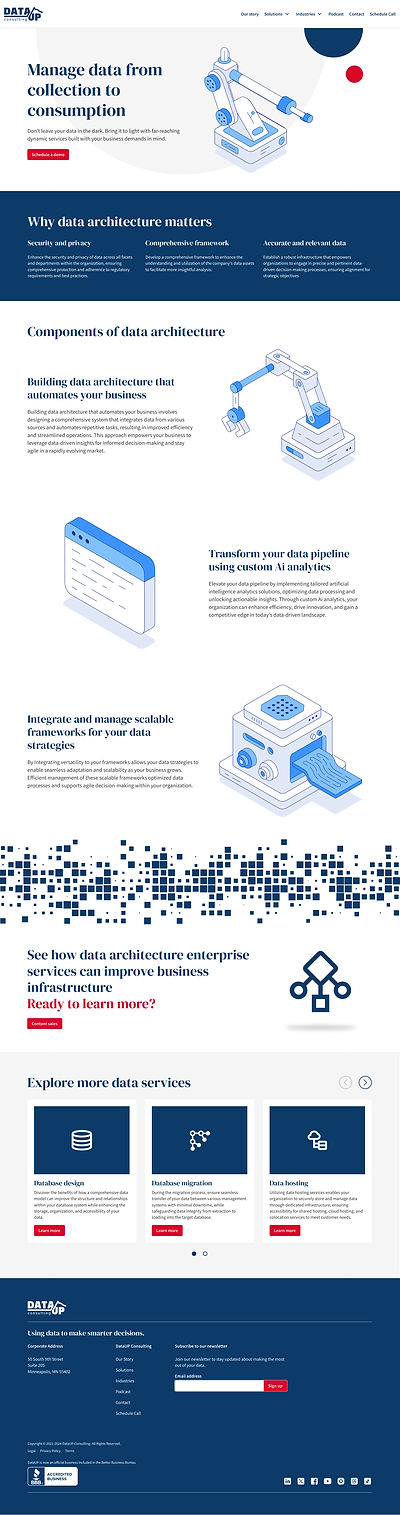
From establishing strategy objectives to final UI mockups that prioritized clarity, accessibility, a better user experience, and improved ways to showcase DataUP's capabilities came together under a unified goal to deliver an experience that the DataUP team could be proud of. The results were a comprehensive set of page designs, including a streamlined Solutions page and an interactive Partnership section—all using a custom-built, standardized Figma component library. These visuals ensured a seamless handoff to development, maintaining consistency across every touchpoint of the DataUP product website.
Homepage

Desktop

Tablet

Mobile


Solutions Landing Page

Desktop: Solutions Detail Page
Tablet

Mobile

The strategic overhaul of the DataUP website resulted in an improved product that combines DataUP’s technical depth with an intuitive user experience. By replacing a fragmented, reactive model, the bounce rate dropped below 40%, and the average engagement time increased by 22 seconds, increasing qualified leads by 7.2%. Key updates, such as the Industries Detail page, now provide immediate social proof and translate complex data science concepts into clear, business-value narratives—showcasing the company's expertise in data architecture and database analytics.
This transformation represents a fundamental shift. The CEO noted the redesign as "a definitive turning point", signaling DataUP’s growth as a data authority. By establishing a scalable, product-focused website platform, DataUP grounded itself as a sophisticated alternative to legacy consultancy firms, ready to evolve alongside the industries it serves.
Conclusion
What I learned
The DataUP product redesign was a lesson in how developing a strategic plan was critical to delivering outcomes for a brand looking to leverage its strengths and expertise. I learned that DataUP's greatest advantage lies in its agility and "Senior-Led Execution," which fills a unique gap often overlooked in larger, legacy firms. By amplifying this strategy, I was able to lean into DataUP's technical capabilities and demonstrate why this matters to business leaders and decision makers. It also taught me that for a growing company, success is not just about aesthetics; it’s about transforming the industries it serves with meaningful solutions and capabilities.


